
Mudwater: Swamp Origins — Rules of Play
Rules of Play. 2 players. About 10 minutes.
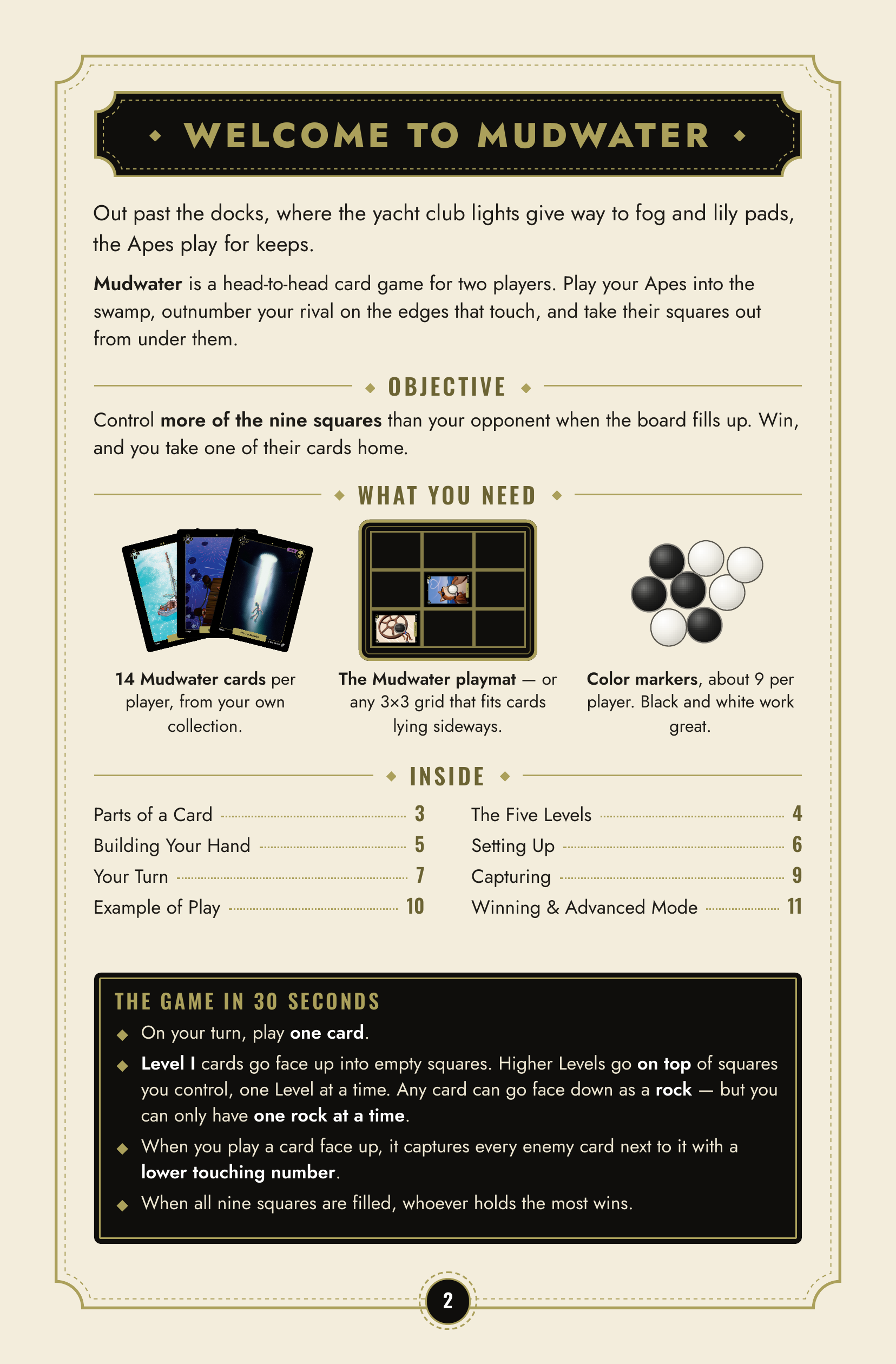
Welcome to Mudwater. Out past the docks, where the yacht club lights give way to fog and lily pads, the Apes play for keeps. Mudwater is a head-to-head card game for two players. Play your Apes into the swamp, outnumber your rival on the edges that touch, and take their squares out from under them. Objective: control more of the nine squares than your opponent when the board fills up. Win, and you take one of their cards home. What you need: 14 Mudwater cards per player, from your own collection; the Mudwater playmat, or any 3×3 grid that fits cards lying sideways; colour markers, about 9 per player — black and white work great. The game in 30 seconds: on your turn, play one card. Level I cards go face up into empty squares. Higher Levels go on top of squares you control, one Level at a time. Any card can go face down as a rock, but you can only have one rock at a time. When you play a card face up, it captures every enemy card next to it with a lower touching number. When all nine squares are filled, whoever holds the most wins.
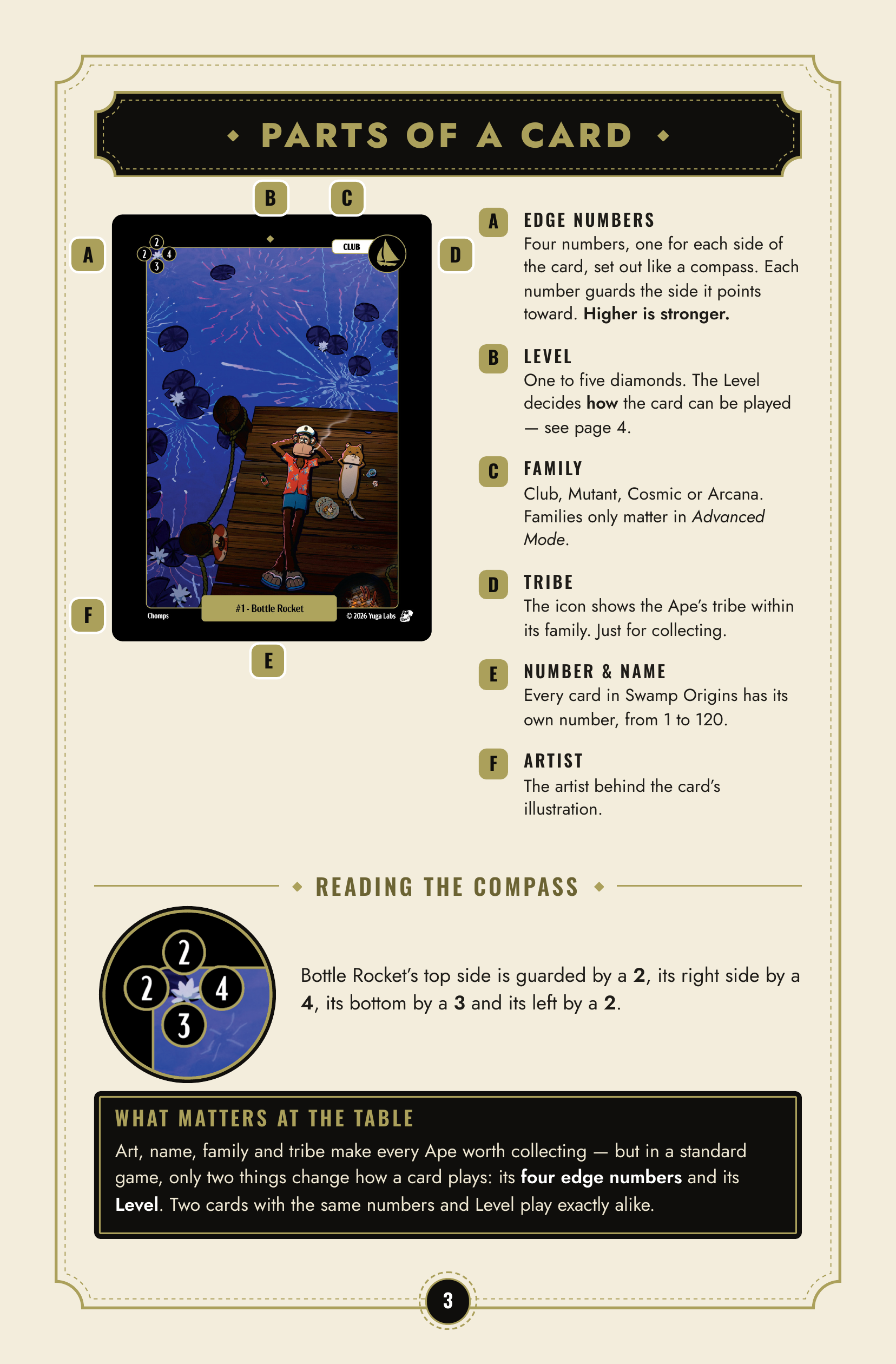
Parts of a card. A — Edge numbers: four numbers, one for each side of the card, set out like a compass. Each number guards the side it points toward. Higher is stronger. B — Level: one to five diamonds. The Level decides how the card can be played. C — Family: Club, Mutant, Cosmic or Arcana. Families only matter in Advanced Mode. D — Tribe: the icon shows the Ape's tribe within its family. Just for collecting. E — Number and name: every card in Swamp Origins has its own number, from 1 to 120. F — Artist: the artist behind the card's illustration. Reading the compass: Bottle Rocket's top side is guarded by a 2, its right side by a 4, its bottom by a 3 and its left by a 2. What matters at the table: art, name, family and tribe make every Ape worth collecting, but in a standard game only two things change how a card plays — its four edge numbers and its Level. Two cards with the same numbers and Level play exactly alike.
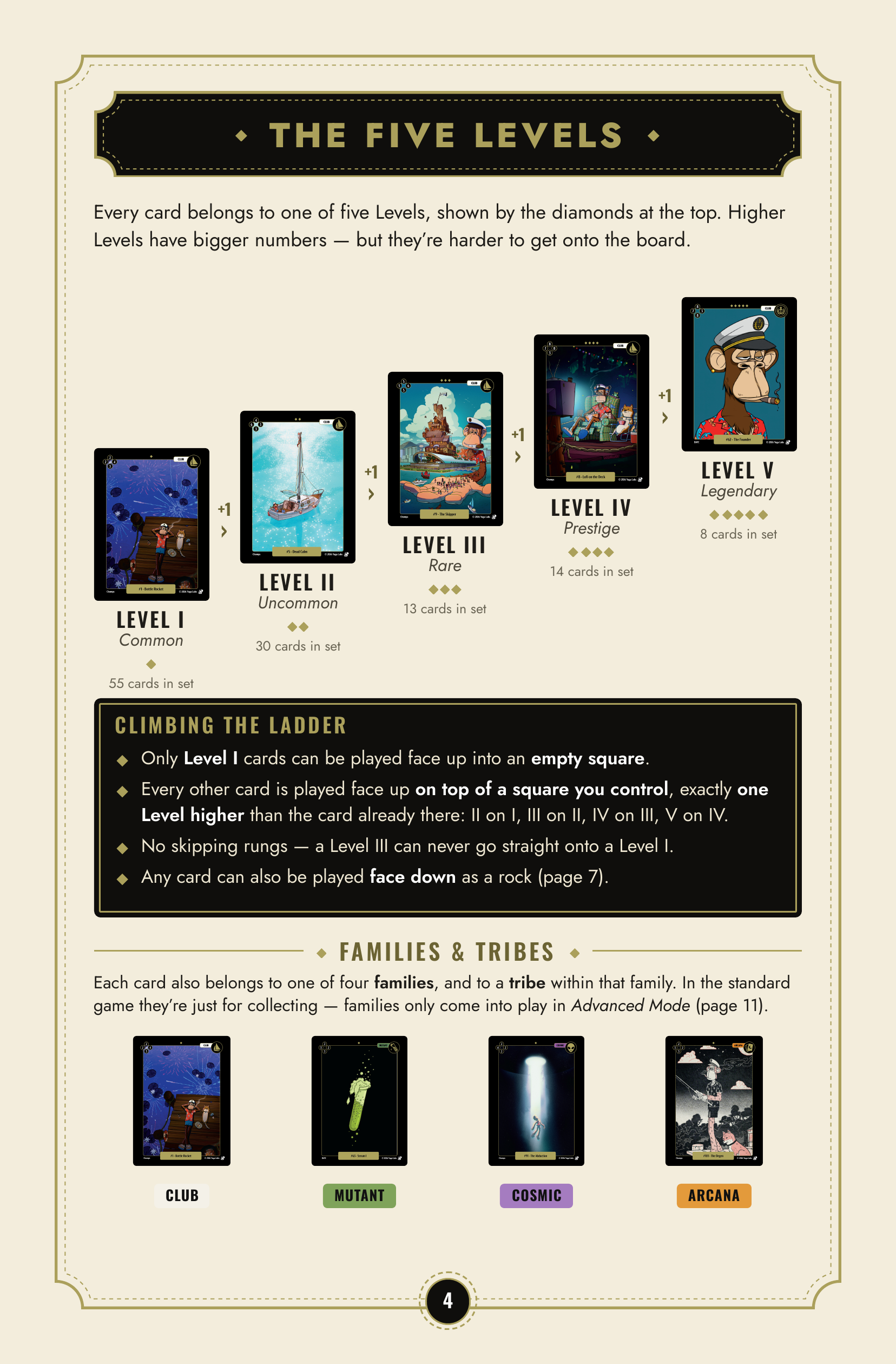
The five Levels. Every card belongs to one of five Levels, shown by the diamonds at the top. Higher Levels have bigger numbers, but they're harder to get onto the board. Level I Common, 55 cards in set. Level II Uncommon, 30 cards in set. Level III Rare, 13 cards in set. Level IV Prestige, 14 cards in set. Level V Legendary, 8 cards in set. Climbing the ladder: only Level I cards can be played face up into an empty square. Every other card is played face up on top of a square you control, exactly one Level higher than the card already there — II on I, III on II, IV on III, V on IV. No skipping rungs: a Level III can never go straight onto a Level I. Any card can also be played face down as a rock. Families and tribes: each card also belongs to one of four families — Club, Mutant, Cosmic, Arcana — and to a tribe within that family. In the standard game they're just for collecting; families only come into play in Advanced Mode.
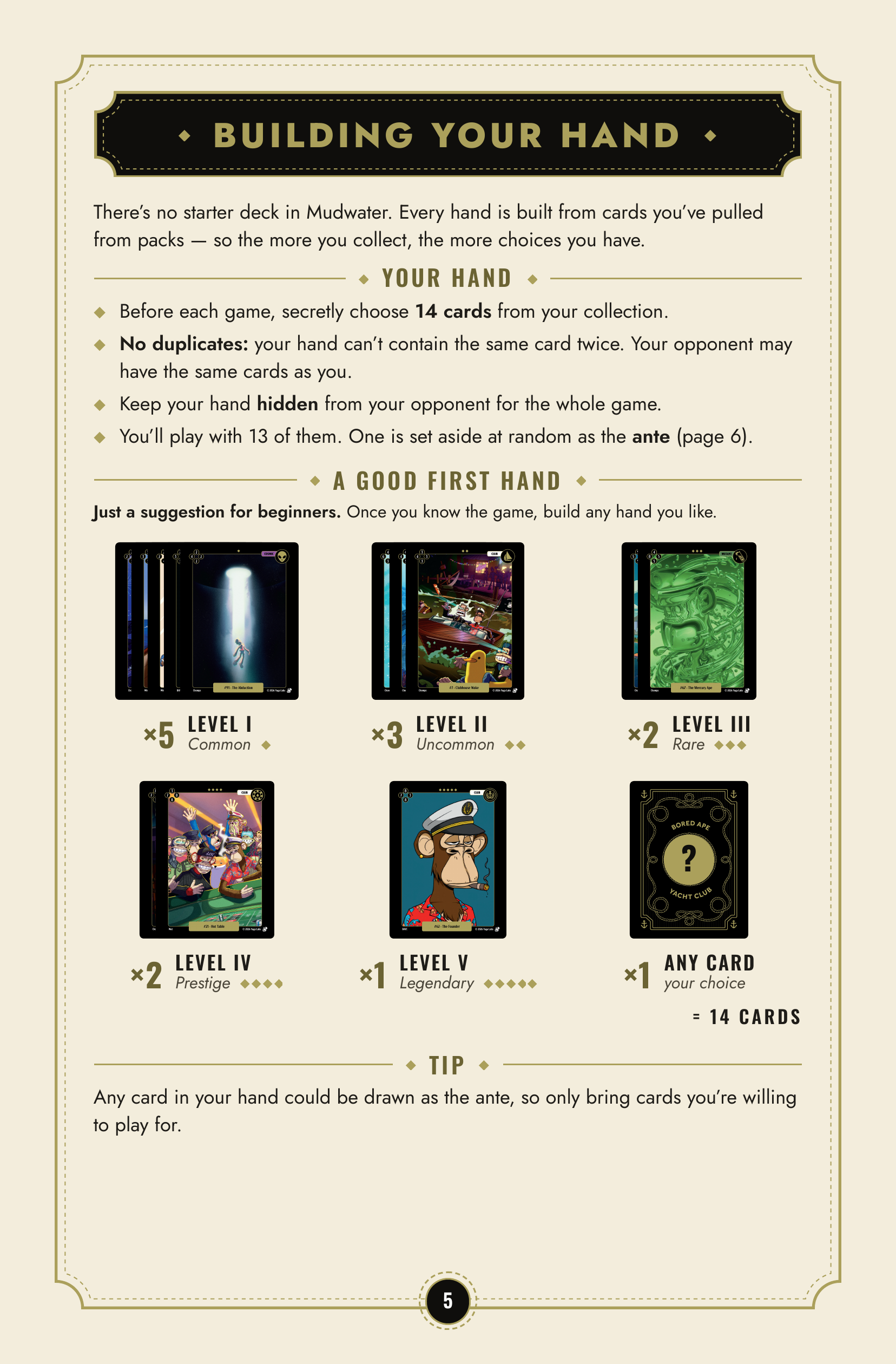
Building your hand. There's no starter deck in Mudwater. Every hand is built from cards you've pulled from packs, so the more you collect, the more choices you have. Your hand: before each game, secretly choose 14 cards from your collection. No duplicates — your hand can't contain the same card twice, though your opponent may have the same cards as you. Keep your hand hidden from your opponent for the whole game. You'll play with 13 of them; one is set aside at random as the ante. A good first hand, just a suggestion for beginners: five Level I Common, three Level II Uncommon, two Level III Rare, two Level IV Prestige, one Level V Legendary, and one card of your choice — 14 cards in all. Once you know the game, build any hand you like. Tip: any card in your hand could be drawn as the ante, so only bring cards you're willing to play for.
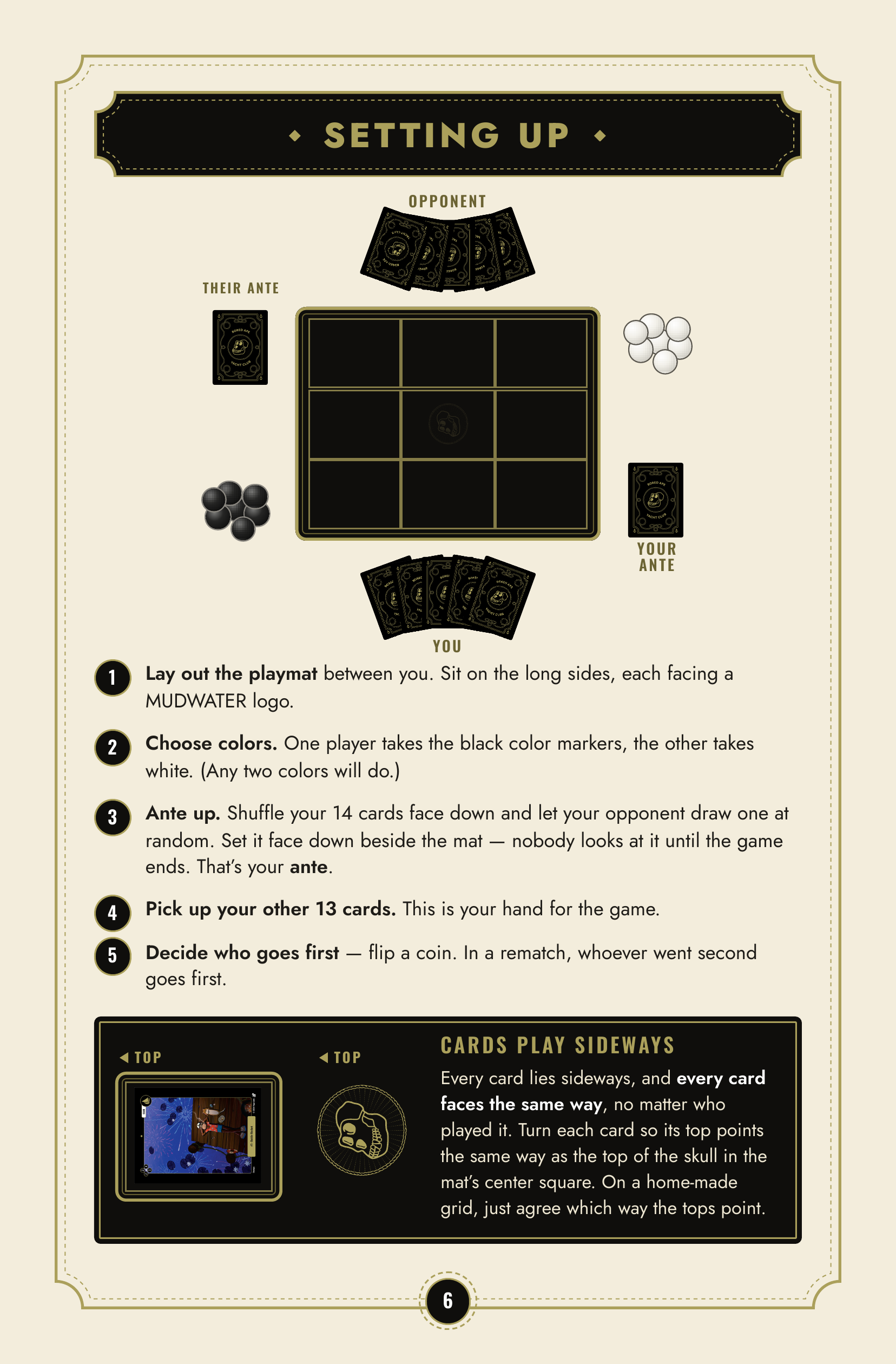
Setting up. 1: lay out the playmat between you. Sit on the long sides, each facing a Mudwater logo. 2: choose colours. One player takes the black colour markers, the other takes white. Any two colours will do. 3: ante up. Shuffle your 14 cards face down and let your opponent draw one at random. Set it face down beside the mat — nobody looks at it until the game ends. That's your ante. 4: pick up your other 13 cards. This is your hand for the game. 5: decide who goes first by flipping a coin. In a rematch, whoever went second goes first. Cards play sideways: every card lies sideways, and every card faces the same way, no matter who played it. Turn each card so its top points the same way as the top of the skull in the mat's centre square. On a home-made grid, just agree which way the tops point.
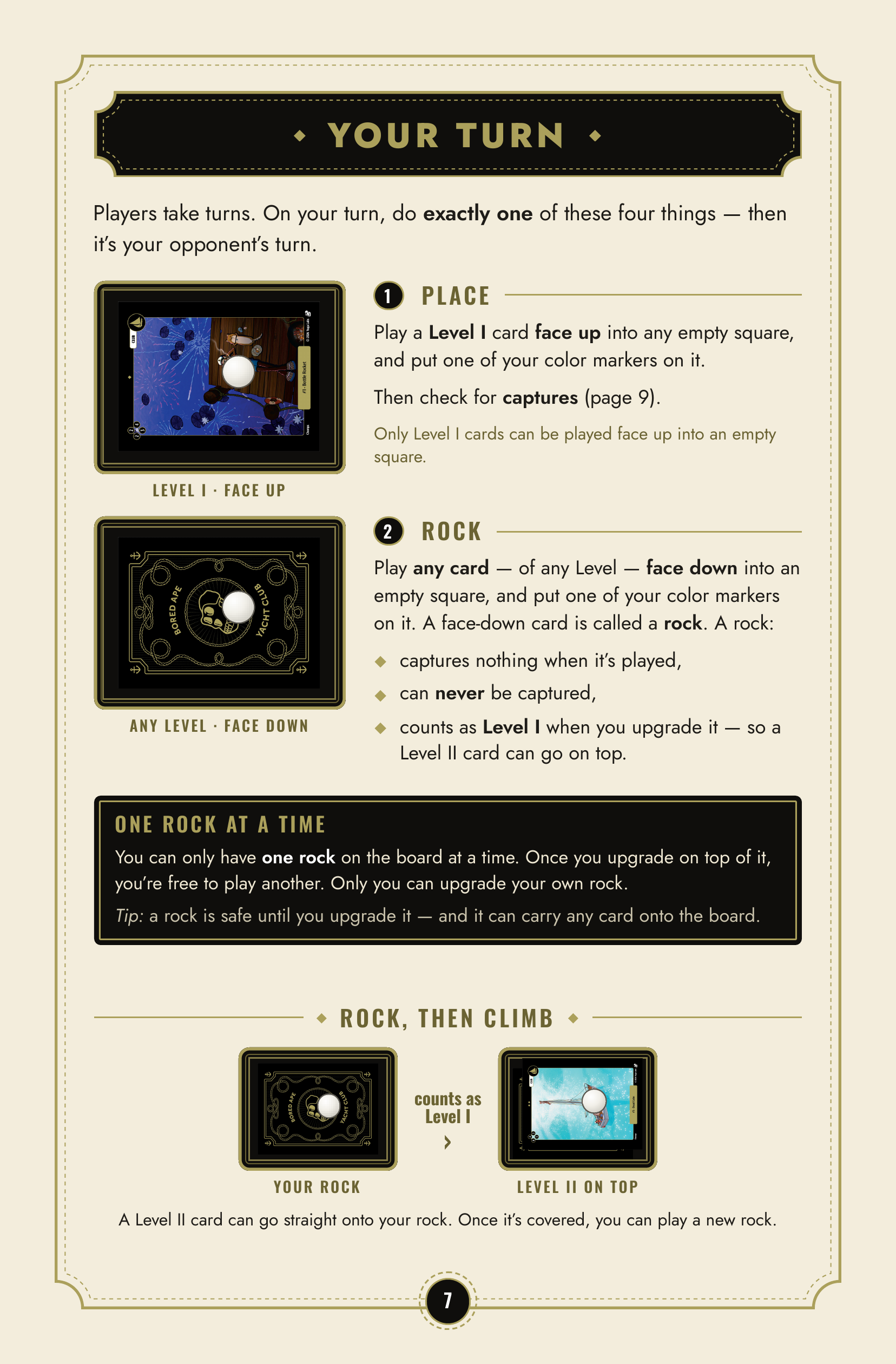
Your turn. Players take turns. On your turn, do exactly one of these four things, then it's your opponent's turn. 1 — Place: play a Level I card face up into any empty square, and put one of your colour markers on it. Then check for captures. Only Level I cards can be played face up into an empty square. 2 — Rock: play any card, of any Level, face down into an empty square, and put one of your colour markers on it. A face-down card is called a rock. A rock captures nothing when it's played, can never be captured, and counts as Level I when you upgrade it — so a Level II card can go on top. One rock at a time: you can only have one rock on the board at a time. Once you upgrade on top of it, you're free to play another. Only you can upgrade your own rock. Tip: a rock is safe until you upgrade it, and it can carry any card onto the board.
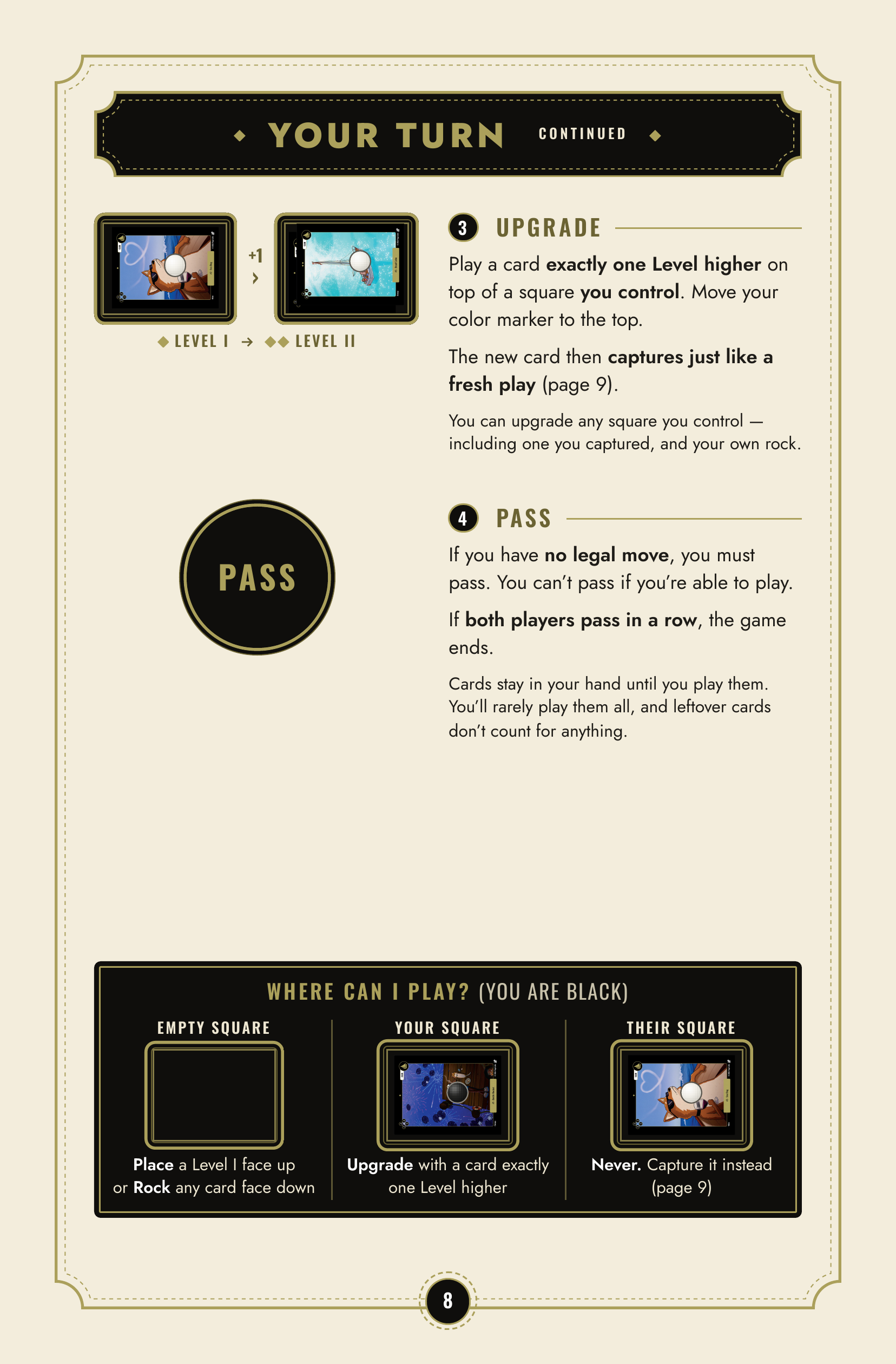
Your turn, continued. 3 — Upgrade: play a card exactly one Level higher on top of a square you control. Move your colour marker to the top. The new card then captures just like a fresh play. You can upgrade any square you control, including one you captured, and your own rock. 4 — Pass: if you have no legal move, you must pass. You can't pass if you're able to play. If both players pass in a row, the game ends. Cards stay in your hand until you play them. You'll rarely play them all, and leftover cards don't count for anything. Where can I play? On an empty square, place a Level I face up or rock any card face down. On your own square, upgrade with a card exactly one Level higher. On their square, never — capture it instead.
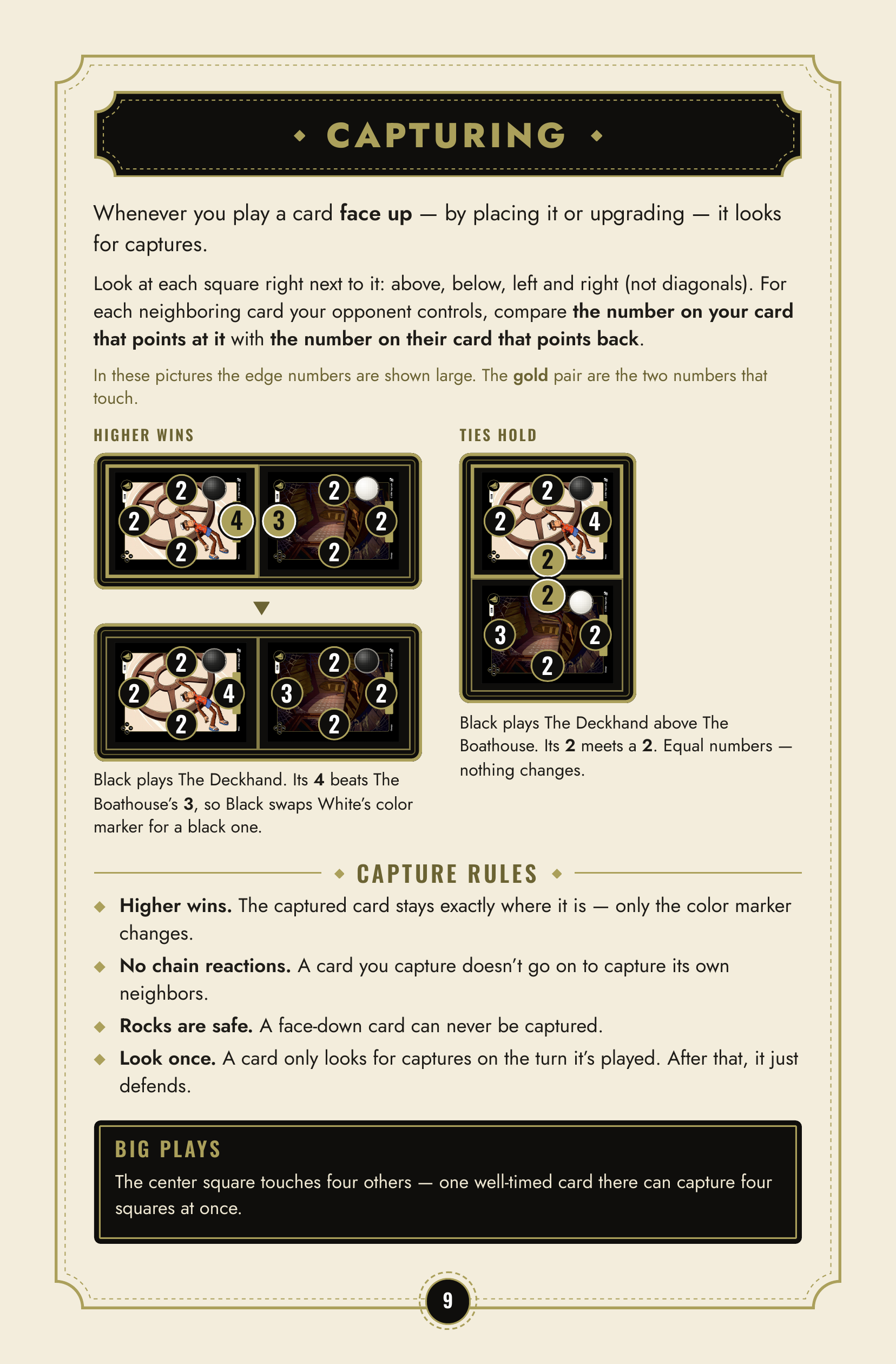
Capturing. Whenever you play a card face up, by placing it or upgrading, it looks for captures. Look at each square right next to it: above, below, left and right, not diagonals. For each neighbouring card your opponent controls, compare the number on your card that points at it with the number on their card that points back. Higher wins: Black plays The Deckhand. Its 4 beats The Boathouse's 3, so Black swaps White's colour marker for a black one. Ties hold: Black plays The Deckhand above The Boathouse. Its 2 meets a 2 — equal numbers, so nothing changes. Capture rules: higher wins, and the captured card stays exactly where it is — only the colour marker changes. No chain reactions: a card you capture doesn't go on to capture its own neighbours. Rocks are safe: a face-down card can never be captured. Look once: a card only looks for captures on the turn it's played; after that, it just defends. Big plays: the centre square touches four others, so one well-timed card there can capture four squares at once.
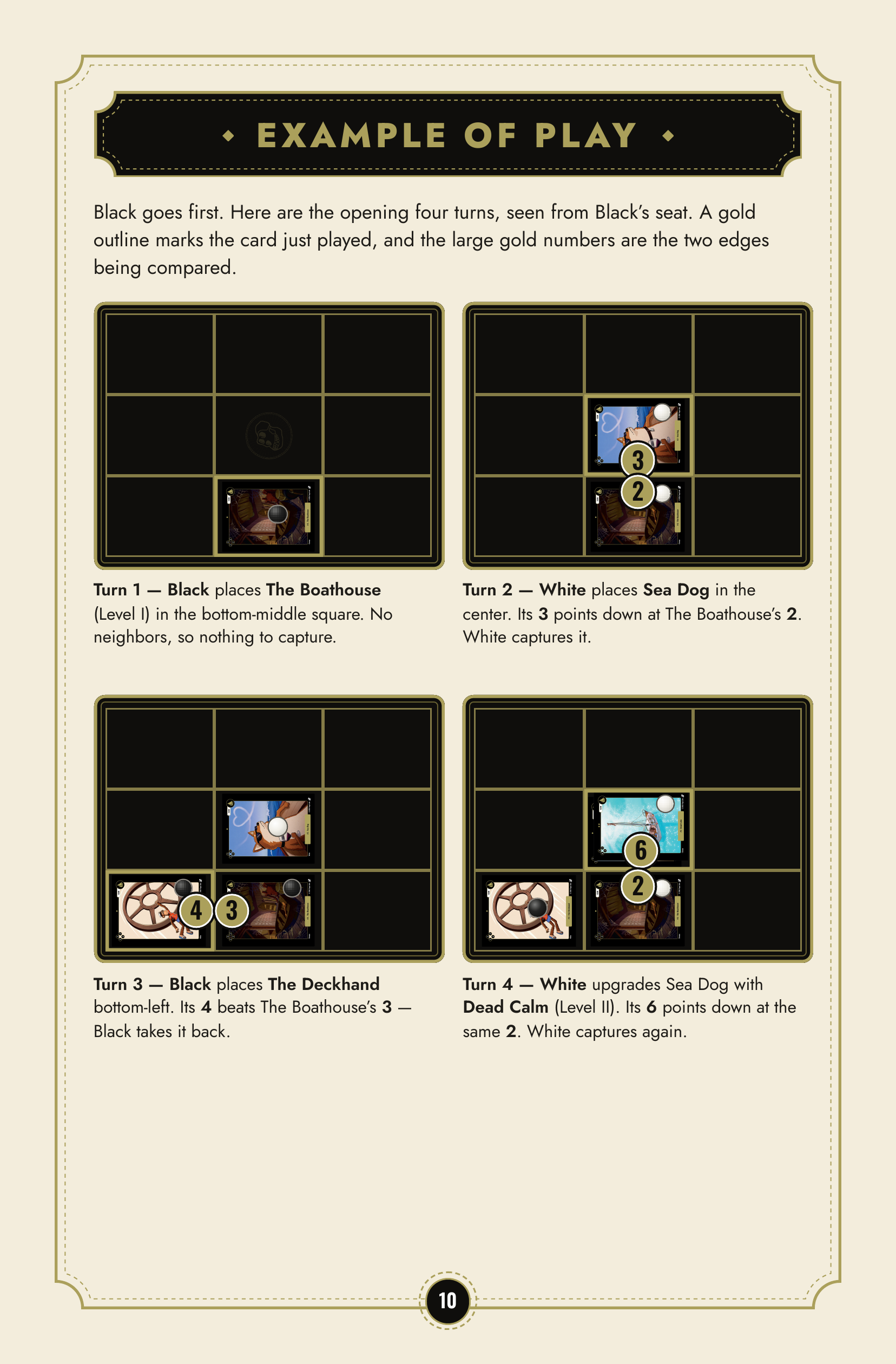
Example of play. Black goes first. Here are the opening four turns, seen from Black's seat. A gold outline marks the card just played, and the large gold numbers are the two edges being compared. Turn 1 — Black places The Boathouse, Level I, in the bottom-middle square. No neighbours, so nothing to capture. Turn 2 — White places Sea Dog in the centre. Its 3 points down at The Boathouse's 2, so White captures it. Turn 3 — Black places The Deckhand bottom-left. Its 4 beats The Boathouse's 3, so Black takes it back. Turn 4 — White upgrades Sea Dog with Dead Calm, Level II. Its 6 points down at the same 2, so White captures again.
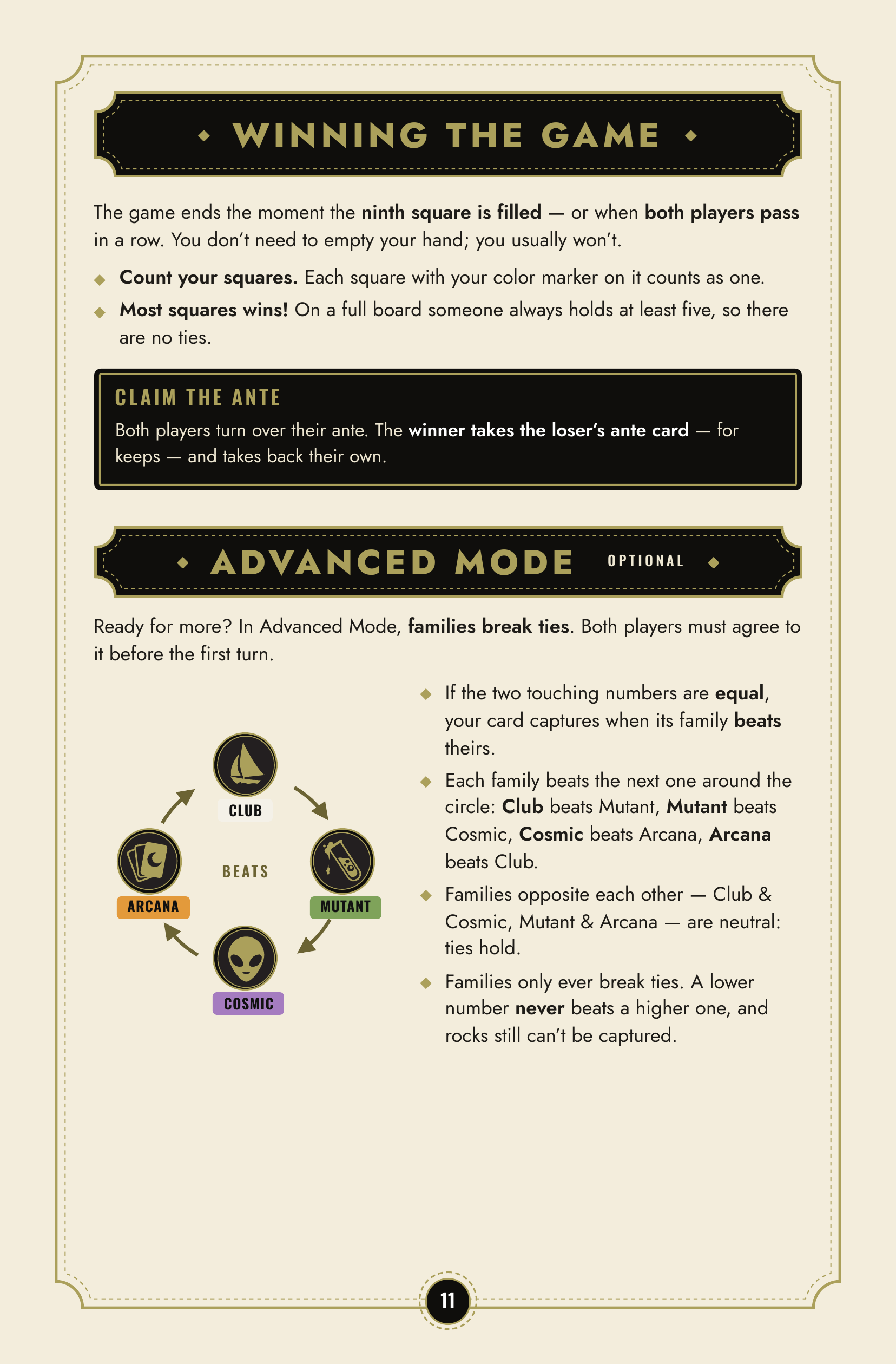
Winning the game. The game ends the moment the ninth square is filled, or when both players pass in a row. You don't need to empty your hand; you usually won't. Count your squares: each square with your colour marker on it counts as one. Most squares wins. On a full board someone always holds at least five, so there are no ties. Claim the ante: both players turn over their ante. The winner takes the loser's ante card, for keeps, and takes back their own. Advanced Mode, optional. Ready for more? In Advanced Mode, families break ties. Both players must agree to it before the first turn. If the two touching numbers are equal, your card captures when its family beats theirs. Each family beats the next one around the circle: Club beats Mutant, Mutant beats Cosmic, Cosmic beats Arcana, Arcana beats Club. Families opposite each other — Club and Cosmic, Mutant and Arcana — are neutral, so ties hold. Families only ever break ties: a lower number never beats a higher one, and rocks still can't be captured.
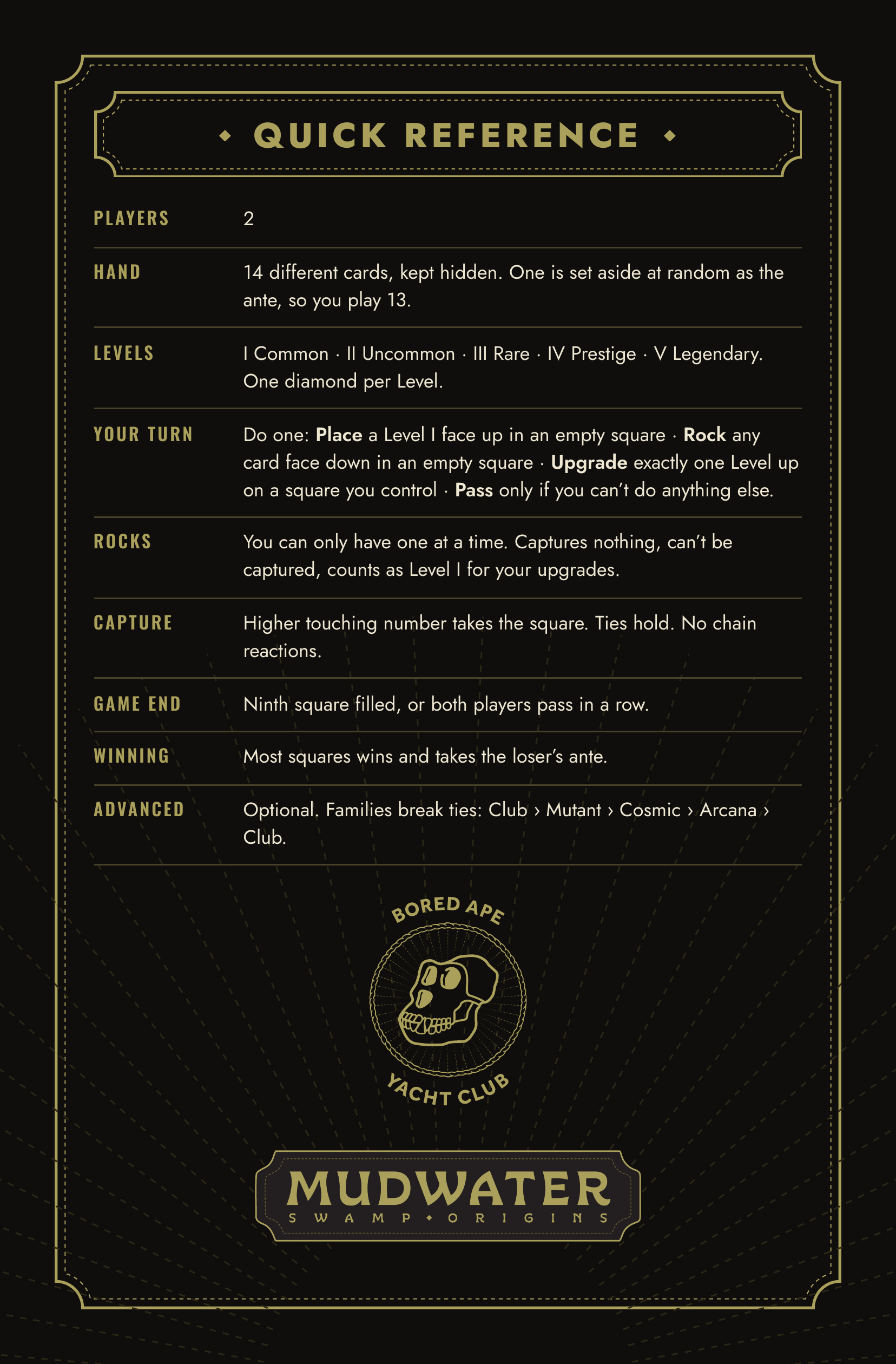
Quick reference. Players: 2. Hand: 14 different cards, kept hidden. One is set aside at random as the ante, so you play 13. Levels: I Common, II Uncommon, III Rare, IV Prestige, V Legendary. One diamond per Level. Your turn: do one — place a Level I face up in an empty square; rock any card face down in an empty square; upgrade exactly one Level up on a square you control; or pass, only if you can't do anything else. Rocks: you can only have one at a time. A rock captures nothing, can't be captured, and counts as Level I for your upgrades. Capture: the higher touching number takes the square. Ties hold. No chain reactions. Game end: the ninth square is filled, or both players pass in a row. Winning: most squares wins and takes the loser's ante. Advanced: optional. Families break ties — Club beats Mutant beats Cosmic beats Arcana beats Club.